You open a crypto wallet, enter an address, type $20, and press Send.
A few moments later, the other person has the money.
It looks almost as simple as sending a message.
But what actually happened?
There was no bank transferring money from one account to another. No company changed a number in its private database. And despite the name, your crypto wallet did not take a few digital coins out of a virtual pocket and send them across the internet.
What happened is much stranger.
There Are No Coins Inside Your Wallet
A crypto wallet is not really a wallet.
It is closer to a keychain.
The cryptocurrency itself exists as information recorded on a blockchain: essentially, a shared history describing which addresses currently have the right to spend certain funds.
Your wallet holds the cryptographic keys that allow you to prove:
“I am allowed to spend the crypto associated with this address.”
The most important of these is your private key.
Think of it as an extremely powerful digital signature. Anyone can see your crypto address, just as anyone can know your bank account number. But only someone with the correct private key can authorize spending from it.
This is why losing a private key can be catastrophic.
There is usually no “Forgot password?” button for the blockchain.
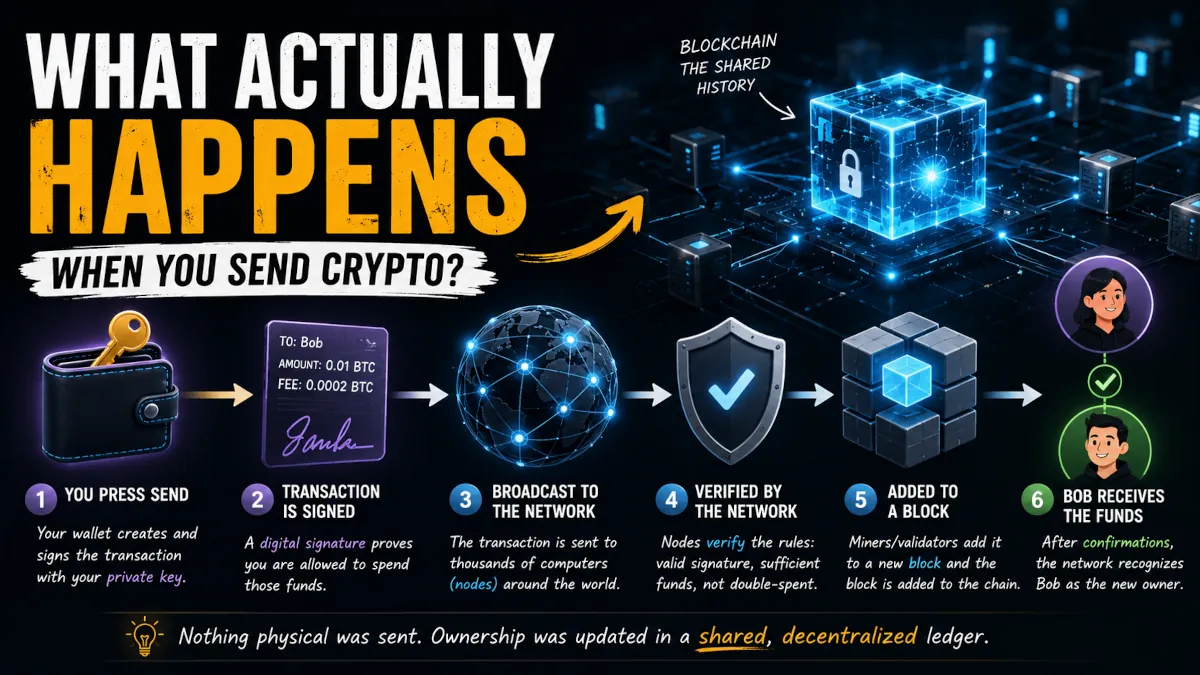
You Press Send
Suppose Alice wants to send some Bitcoin to Bob.
Her wallet first creates a transaction that essentially says:
Transfer this amount of Bitcoin to Bob's address.
But anyone could write that sentence.
The important part comes next.
Alice's wallet uses her private key to create a digital signature for the transaction.
That signature proves that the transaction was authorized by the person controlling the correct key—without revealing the private key itself.
Now the transaction is ready to leave Alice's device.
The Network Hears About It
The wallet broadcasts the transaction to computers participating in the Bitcoin network.
These computers pass it to one another.
Soon, thousands of machines may know that Alice wants to pay Bob.
But knowing about a transaction does not make it valid.
The network checks it.
Does the digital signature match?
Does Alice actually control the Bitcoin she is trying to spend?
Has she already spent it somewhere else?
If something is wrong, the transaction is rejected.
If everything looks valid, it can eventually be included in the blockchain.
The Shared Notebook
Imagine thousands of people keeping copies of the same notebook.
Every few minutes, a new page is added describing the latest valid transactions.
The important part is that everyone follows rules for deciding which pages are acceptable.
In Bitcoin, miners compete to produce new blocks using proof of work. In many other cryptocurrencies, validators perform a similar role through systems such as proof of stake.
The details differ, but the basic goal is similar:
get a distributed network to agree on the next valid update to its shared history.
Once Alice's transaction is included in a block, Bob can see that the blockchain now recognizes the payment.
As more blocks are added afterward, reversing that transaction becomes increasingly difficult.
These later blocks are why wallets and exchanges often talk about confirmations.
So What Was Actually Sent?
Here is the strange part.
Nothing resembling a coin travelled from Alice's phone to Bob's phone.
What changed was the network's shared record.
Before the transaction, the blockchain's history said that Alice controlled certain funds.
After the transaction, it says that Bob controls them.
The “transfer” is really a change in who has the cryptographic right to spend what.
And because thousands of independent computers can verify the same history, they do not need a bank to tell them which version is correct.
The Point
A cryptocurrency transaction is not really about moving digital objects.
It is about changing ownership in a shared system without asking a central authority to approve the change.
Your wallet creates the instruction.
Your private key proves that you authorized it.
The network verifies it.
And the blockchain records the result.
Once you understand that, cryptocurrency stops looking quite so mysterious.
The next question is the obvious one:
How can thousands of computers share the same history without someone secretly changing it?
That is where the blockchain itself comes in.

Comments 0
Log in to join the conversation.
Log inStart the conversation.